When I visited Oahu, Hawaii in October 2025, I was surprised by what I found about the island’s electric vehicle charging infrastructure — and not in a good way.
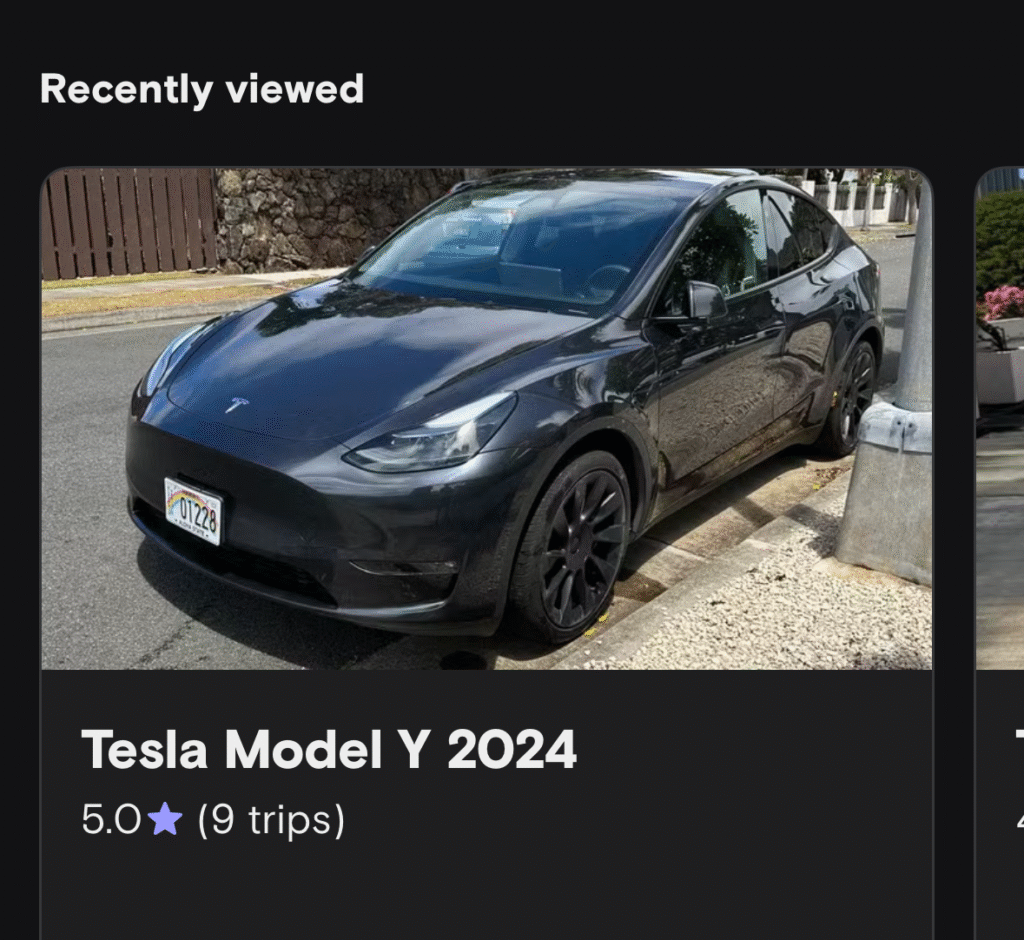
I went there for a long family vacation, and for convenience (and curiosity) decided to rent an electric car — a Tesla Model Y. It was perfect for a family of four: roomy, comfortable, and smooth. But to be honest, I mostly wanted to experience what everyone had been praising. Why does everyone love Tesla so much?
The Model Y I rented through Turo wasn’t one of the new Juniper models, but it was still impressive to a first-time Tesla driver like me — quick, quiet, and cleanly designed. The trouble began the very next day: charging.
It was my fault, really. I hadn’t studied how EV charging works. If I had, I probably wouldn’t have rented an electric car in Hawaii at all.
That’s the short version of today’s post: I learned the hard way.
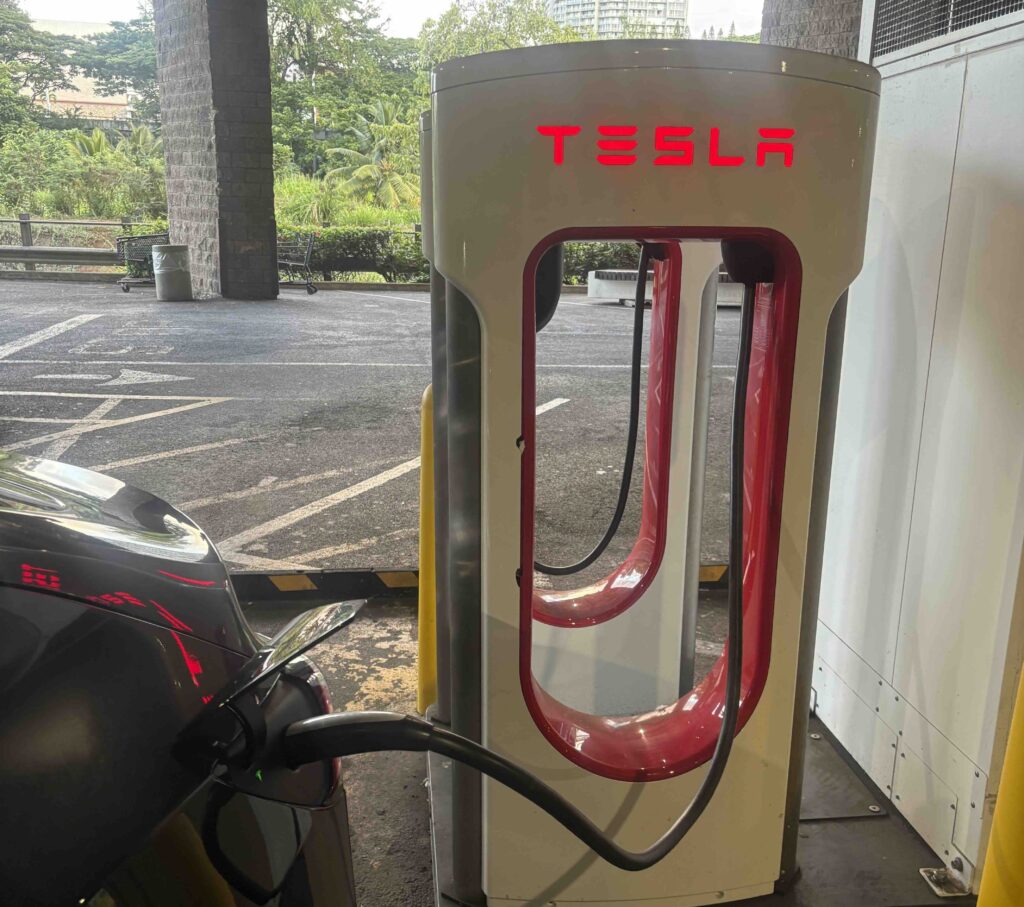
There are only three Tesla Supercharger stations on Oahu. One was added recently; back in October it didn’t even show up on Google Maps. (Maybe a mapping error?) My accommodation was in Ko Olina, which made all of them quite far away. Driving just two full days meant I already needed to recharge — but finding a fast charger nearby was a challenge.
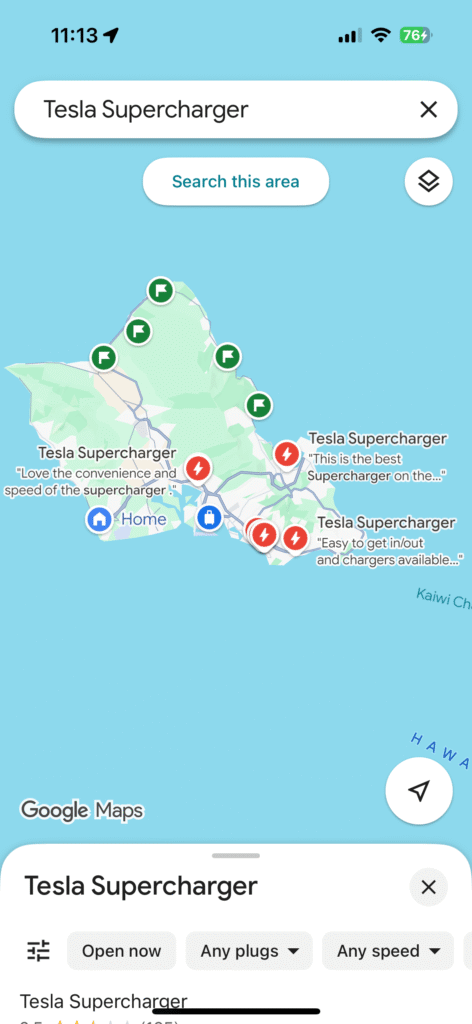
The car owner had only provided a J1772 adapter (for AC slow charging), not the faster CCS1 DC combo adapter. I didn’t realize how crucial that was. Using a J1772 meant it would take nearly an entire day to reach a full charge. Even with the CCS1 adapter, it wouldn’t have been easy — with only about 10 percent battery left, a full charge would still take an hour or more, and DC chargers themselves were scarce. The nearest one was at the Walmart in Kapolei.
By day three, I even considered buying a CCS1 adapter outright. But wasting precious vacation time hunting one down felt ridiculous, so I gave up. Instead, I did the next best (and slightly foolish) thing: driving into town early every morning to fully charge at a Supercharger before starting the day.
Looking back, I can laugh — but in the moment, it was nerve-racking. The first time I plugged in at a public charger in a mall parking lot, the screen told me it would take 23 hours to reach full charge. (Tesla displays the estimated charging time right on the screen.) Total panic. I stretched my shopping as long as possible — about three and a half hours — and ended up with roughly 14 percent battery.
The next day, I wasn’t even sure if I could make it back into town. Thankfully, I didn’t end up stranded on the roadside, but that experience was enough to make me swear I’d never repeat it.
| Category | 🇺🇸 United States | 🇰🇷 South Korea | Summary |
|---|---|---|---|
| EV adoption scale | ~1,400,000 units (2023 annual sales) | ~543,900 units (2023 cumulative registrations) | U.S. has about 2.5× more EVs overall |
| Public chargers | ~195,000 (as of Jan 2025) | ~350,000 (as of Jun 2024) | Korea has nearly twice as many chargers — far higher density for its size |
| Ratio (EV : charger) | 7 : 1 (7 cars per charger) | 1.5 : 1 (1.5 cars per charger) | Korea has ~4.5× better charger coverage |
| Accessibility | Urban-centric; highway-focused; limited in rural areas | Nationwide coverage including public lots and apartments | Korea far superior in spatial accessibility |
| Density per land area | 9.8M km² / 195,000 chargers → 1 per 50 km² | 100k km² / 350,000 chargers → 1 per 0.28 km² | ~180× denser infrastructure in Korea |
| Charging speed & grid | Ultra-fast DC; Tesla Supercharger dominance | Mix of AC/DC; rapid transition to fast chargers | U.S. leads in speed, Korea in charger quantity |
| Market maturity | Market-driven; wide brand diversity | Policy-driven; infrastructure-first model | U.S.: market-led / Korea: infrastructure-led |
Although the U.S. has far more EVs overall, Korea has nearly double the number of chargers.
In the U.S., there are about seven cars per public charger, while Korea’s ratio is only about 1.5 per charger.
That means Korea’s charging network is roughly 180 times denser when adjusted for land area.
The U.S. may be a production powerhouse for electric vehicles, but its charging infrastructure still has a lot of catching up to do.
Sources
- U.S. Department of Energy (2024 Jan)
- Climate Central (2025 Jan)
- Recurrent Auto / ICCT Report (2024 Oct)
- The Korea Times (2024 Apr)
- FOURIN Report (2024 Jun)
- Mordor Intelligence (2023)
Tech for Better Living
Small technologies, real change.